New tiny sensor makes the invisible visible
Miniaturized near-infrared sensor that could fit in a smartphone can analyze the chemical content of milk and plastics.
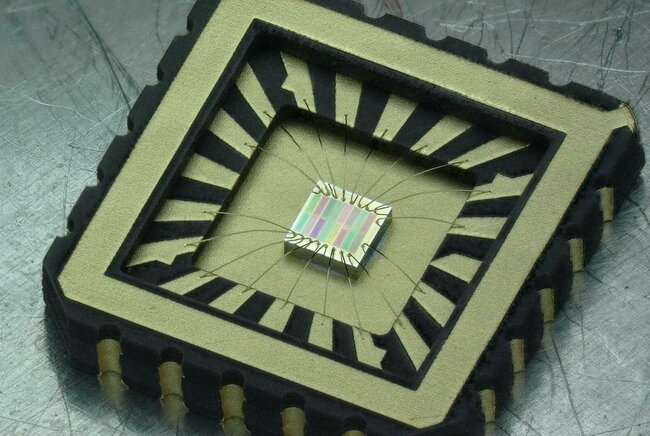
A 果冻传媒 research group has developed a new near-infrared sensor that is easy to make, comparable in size to sensors in smartphones, and ready for immediate use in industrial process monitoring and agriculture. This breakthrough has just been published in Nature Communications, with co-first author Kaylee Hakkel defending her PhD thesis on January 14th.
The human eye is a marvelous sensor. Using three different types of photoreceptor cone cells that convert visible light into signals for different colors, the eye gives essential information about the world around us.
鈥淲hen our brain puts the signals together, it makes a prediction of what the signals mean based on our experiences. For example, a red strawberry is sweet, but a green one is not鈥�, explains , PhD researcher in the Photonics and Semiconductor Nanophysics group at the department of Applied Physics and co-first author of the study.
Size does matter
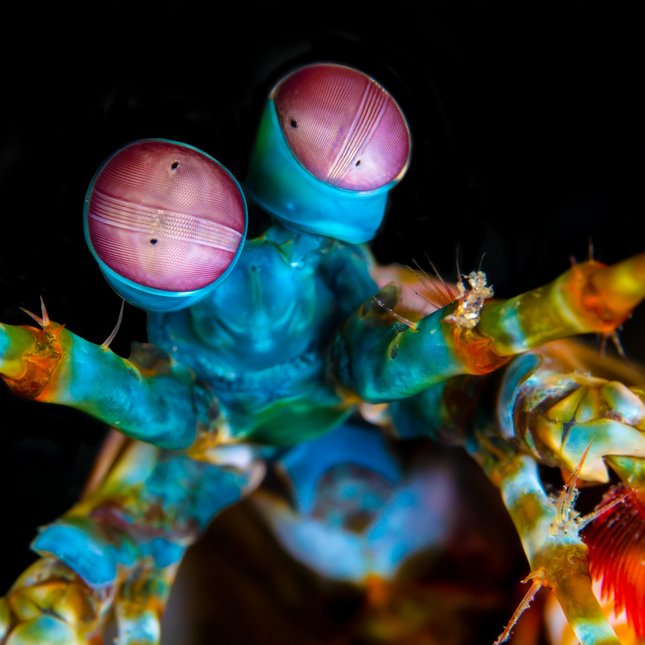
While the human eye is impressive, it鈥檚 far from being the most advanced natural light sensor out there. 鈥淭he eyes of the Mantis shrimp have 16 different types of cells, which are sensitive to ultraviolet light, visible, and near-infrared (NIR) light,鈥� says Hakkel. 鈥淎nd measuring the spectrum in the infrared is most interesting for applications in industry and agriculture, but there鈥檚 one major issue 鈥� current near-infrared spectrometers are just too big and expensive.鈥�
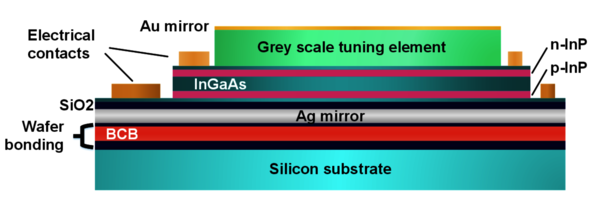
Hakkel and her collaborators have solved this issue by developing a near-infrared sensor that fits onto a small chip. And just like the eye of the Mantis shrimp, it鈥檚 got 16 different sensors 鈥� but they are all sensitive in the near-infrared. 鈥淢iniaturization of the sensors while keeping costs low was a major challenge. So, we designed a new wafer-scale fabrication process to achieve this.鈥�
鈥淚t鈥檚 low-cost because we can produce multiple sensors at the same time, and it鈥檚 ready, right now, for use in practical applications in the real world,鈥� Hakkel adds. 鈥淭he sensor chip is small and could even be embedded in future smartphones.鈥�
Solving spectral sensing
Andrea Fiore, research lead from the Department of Applied Physics and the Eindhoven Hendrik Casimir Institute, is delighted with their research team鈥檚 work. 鈥淲e鈥檝e been investigating this technology for a number of years. And now we鈥檝e successfully integrated the spectral sensors on a chip, while also dealing with another key issue 鈥� efficient use of the data鈥�
Normally, when a sensor measures light, the generated signal is used to reconstruct the optical spectrum 鈥� or optical fingerprint 鈥� for the material. Sensing algorithms are then used to analyze the data.
In this new approach, the researchers show that the step of spectral reconstruction isn鈥檛 needed. In other words, the signals generated by the sensors can be sent straight to the analysis algorithms. 鈥淭his significantly simplifies the design requirements for the device,鈥� notes Fiore.
Analyzing milk and plastics
With the sensor in hand, the researchers then tested the sensor in a number of experiments, as explained by co-first author Maurangelo Petruzzella, who is also working at the startup company MantiSpectra. 鈥淲e used the sensor to measure the nutritional properties of many materials including milk. Our sensor provided comparable accuracy in the prediction of fat content in milk as conventional spectrometers. And then we used the sensor to classify different types of plastic.鈥�
The nutritional properties of milk determine its economic value, and the sensor has been proven to accurately measure these properties. In addition, these measurements could be used to monitor the cow鈥檚 overall health. Classification of plastic types using the sensor can help to optimize waste sorting processes.
鈥淏esides these applications, we anticipate that the sensor could be used for personalized health care, precision agriculture (monitoring the ripeness of fruit and vegetable for instance), process control, and lab-on-chip testing. We now have a full development kit available based on this technology, the SpectraPod鈩�, that companies and research institutes are using to build their applications. And the great thing is that this sensor could even be commonplace in the smartphones of the future meaning that people could use it at home to check the quality of their food or check aspects of their health,鈥� adds Petruzzella.
MantiSpectra future
And things are just starting to get exciting for Hakkel, who defends her thesis on January 14th at 果冻传媒. Afterwards, she鈥檒l be joining Petruzzella at the startup company MantiSpectra where they will strive to advance the sensor for more practical applications. 鈥淚鈥檓 really excited to start working on the next phase of the sensor development with MantiSpectra. This sensor could contribute to a cleaner environment and address food waste, applications that are important for everyone.鈥�
FULL PAPER DETAILS
"", Kaylee D. Hakkel, Maurangelo Petruzzella, et al., Nature Communications, (2022).
Media contact
More on Health
![[Translate to English:]](https://assets.w3.tue.nl/w/fileadmin/_processed_/2/2/csm_Banner%20image%20Jaap%20van%20der%20Aar_4650434764.jpg "[Translate to English:]")


Latest news
